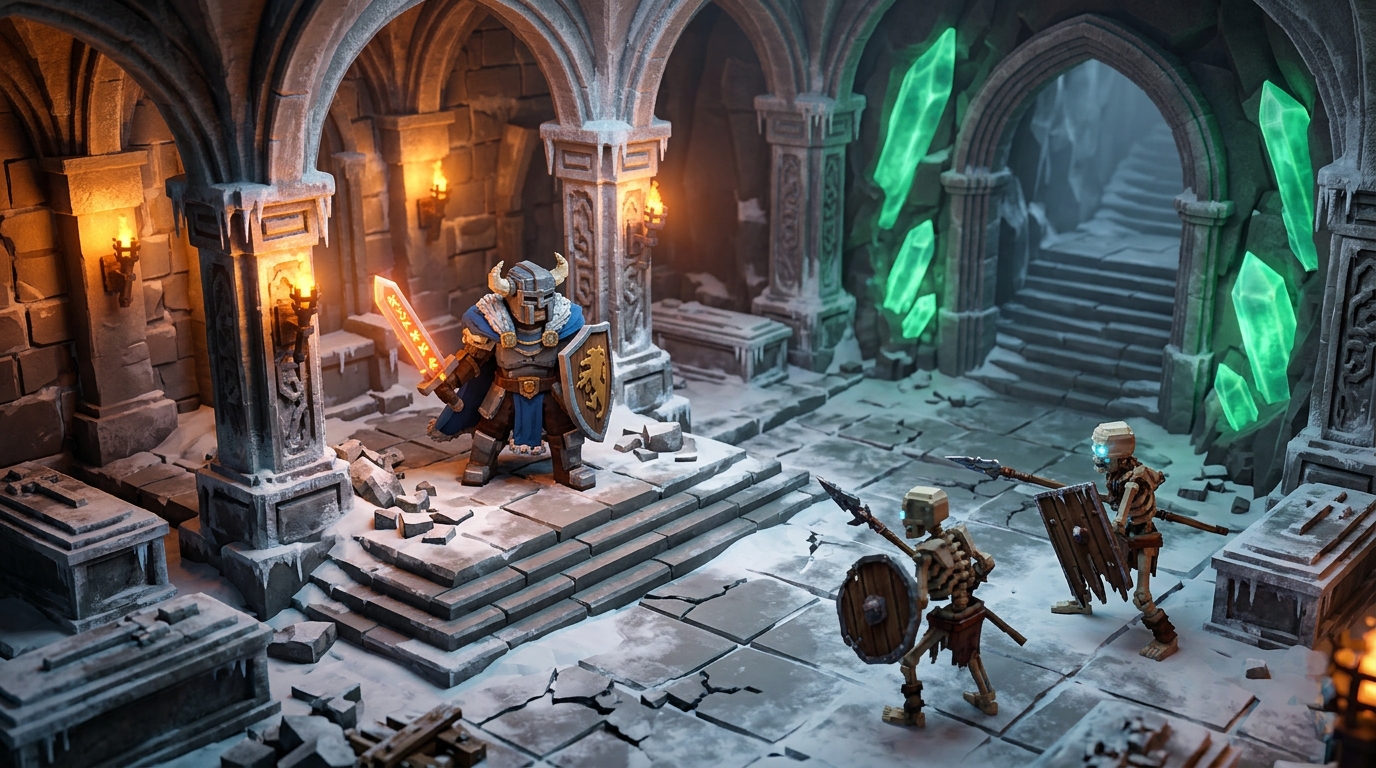
Back in my teenage years, there was one holiday when friends and I booked a chalet and played tabletop Dungeons & Dragons non-stop for a few days. Everything ran on paper, pencil, an eraser, and a tray of polyhedral dice. Our Game Master arrived with a small stack of books and had to flip between different volumes whenever a spell, monster, or saving throw came up—back then, Forgotten Realms was a whole series, and he used to encourage us to go to the library to borrow and read the books for the lore, though I was too lazy and never much of a reader. The rest of us just held onto our paper character sheets, threw the dice across the table, erased and rewrote stats, and tracked every hit point by hand.
Later on, I played digital RPGs like Neverwinter Nights, Dragon Age, and Skyrim on console—from pausing mid-fight in an Aurora-engine-style three-quarter view to getting lost in sprawling fantasy worlds. And with the System Reference Document 5.2 (SRD 5.2) released under CC-BY-4.0, I finally had the chance to bring both worlds together by building a tabletop-faithful RPG in code.
The result is Jadefrost , a 3D isometric, real-time-with-pause RPG built in Godot 4.7 on the SRD 5.2 ruleset.
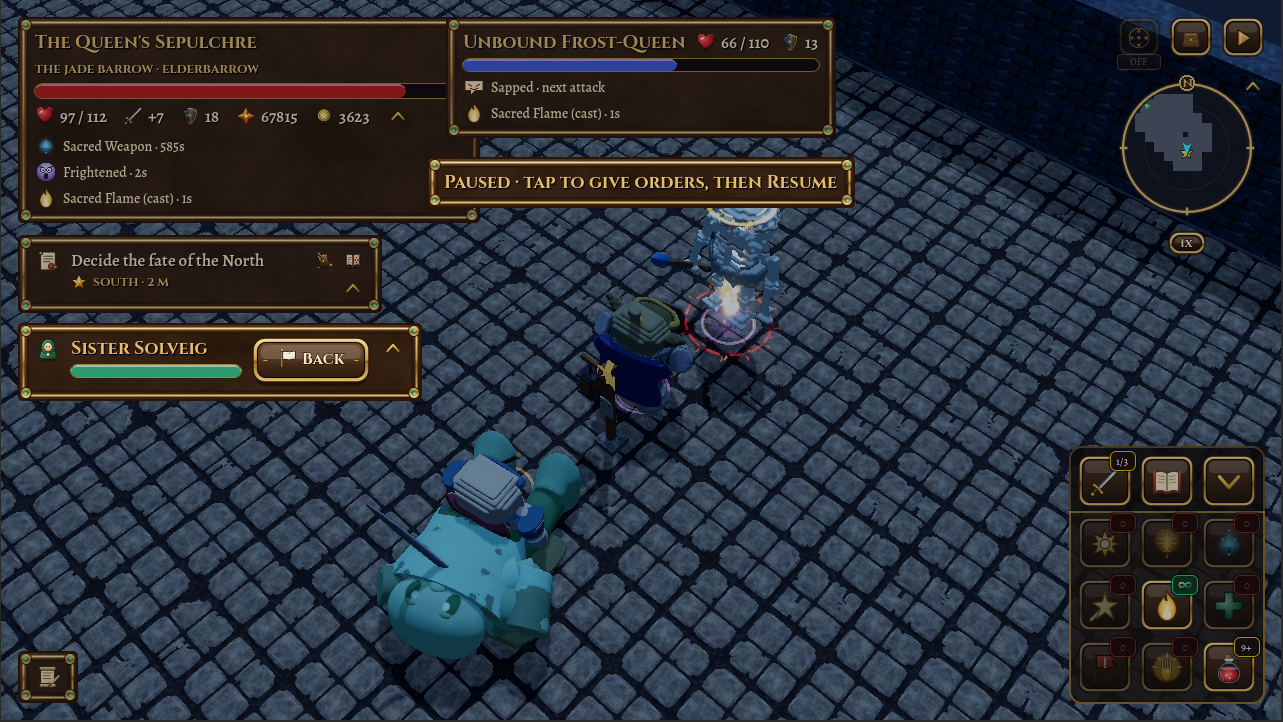
▶ Play Jadefrost in your browser on itch.io — playable on desktop and mobile landscape, with no install required.
1. Architecture & Pillars
Right after finishing The Jade Crypt , development on Jadefrost kicked off across the rules engine, campaign, 3D asset kits, and WebGL2 export pipeline.
The project settled into a few distinct pillars:
-
Tabletop Session Zero & Pure Rules Domain (
domain/): The game opens like a night at the chalet table. The Game Master reads the prologue (data/story/prologue.txt), then slides a blank SRD 5.2 character sheet across the screen. All 12 classes, 9 species across 24 lineages, and 4 backgrounds from the official SRD 5.2 tables are on the sheet. Rolling4d6-drop-lowest (up to three tries, keep any set) is the default ritual, with Standard Array and Point Buy one tap away. Everything underdomain/is plainRefCounted/ResourceGDScript with no scene nodes, allowing the headless test suite (tests/run_tests.gd) to run 27,135 assertions across 14 suites in seconds.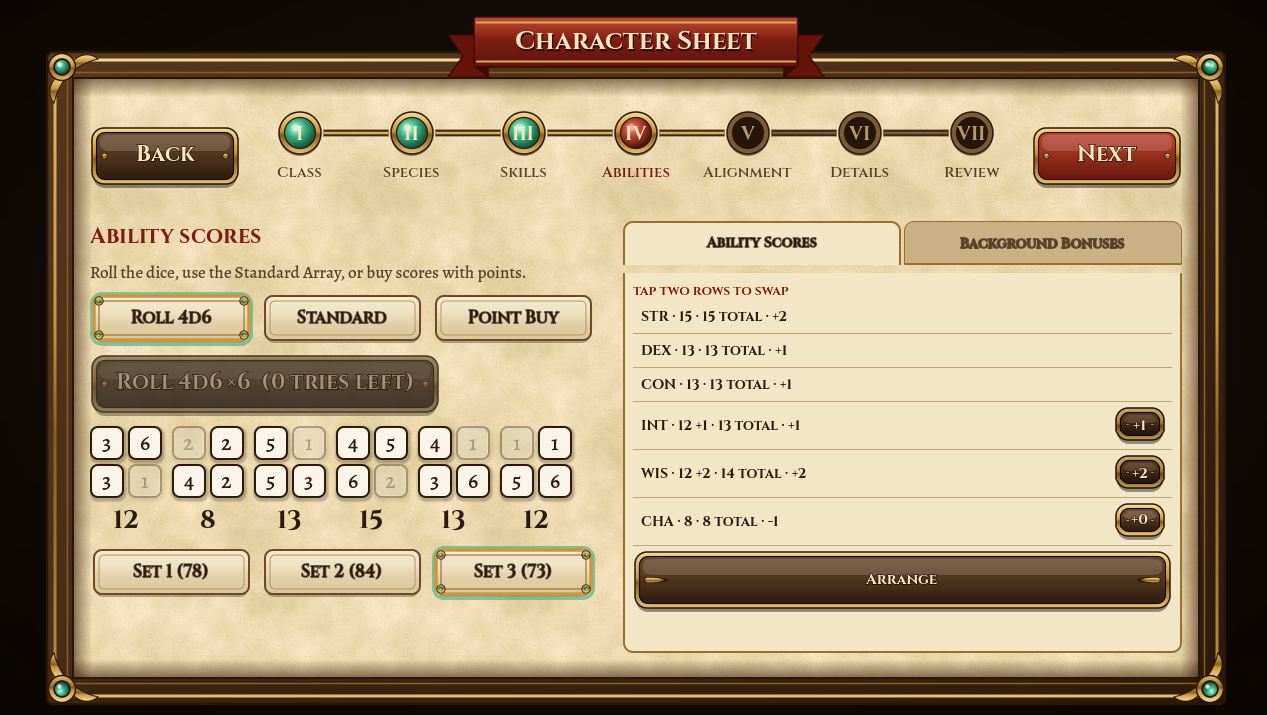
-
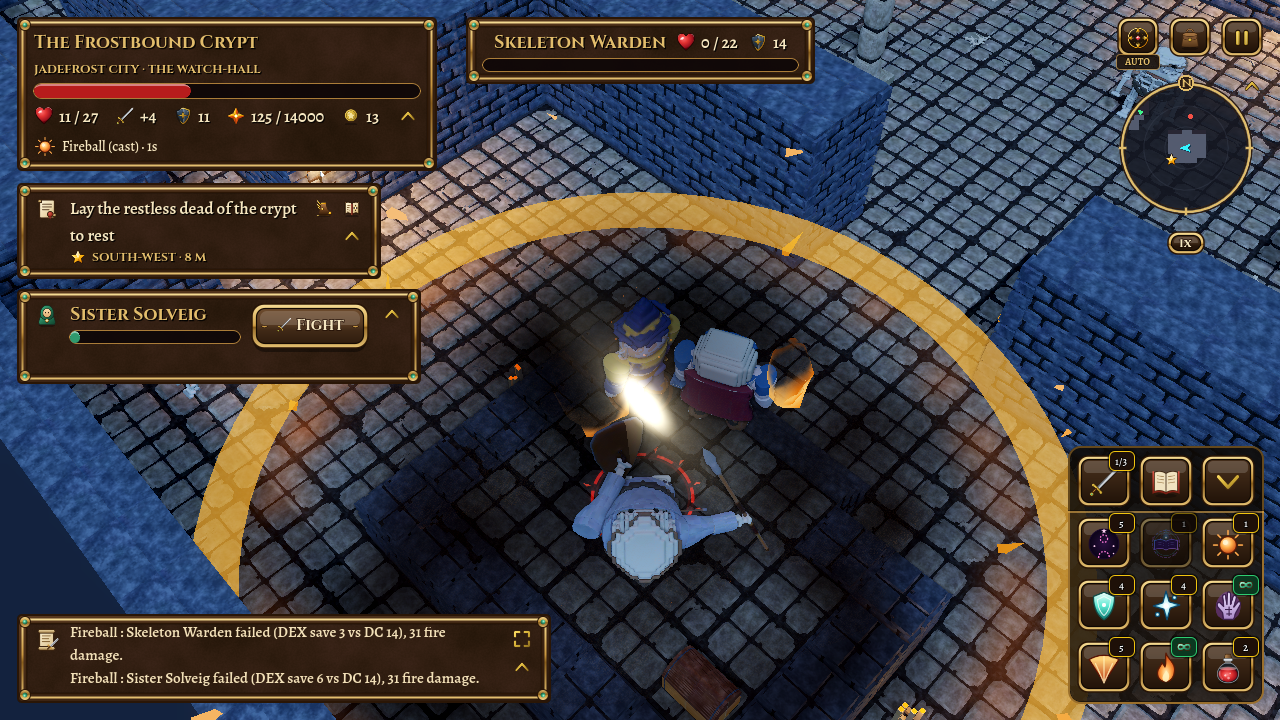
Real-Time-with-Pause Combat & Three-Act Campaign: Combat runs on a compressed tabletop clock with pause-anytime order queuing, d20 rolls printed in the combat log, 26 playable spells, 36 quests across a three-act campaign (levels 1–10), a companion (Sister Solveig), voiced NPC dialogue, and a Watch-Hall training yard before you descend into the Frostbound Crypt.
-
Terrain3D & WebGL2 Release Engineering: Outdoor maps render with Terrain3D on desktop; because Terrain3D ships desktop binaries only, the WebGL2 browser build falls back to Godot’s built-in terrain mesh builder while keeping the same gameplay and collision. To fit itch.io’s 200 MB per-file Web limit, model atlases were switched to WebP, export exclusions tightened,
tools/split_web_pck.pyadded to splitindex.pckinto ≤150 MB chunks, and mobile Web Audio unlock fixed.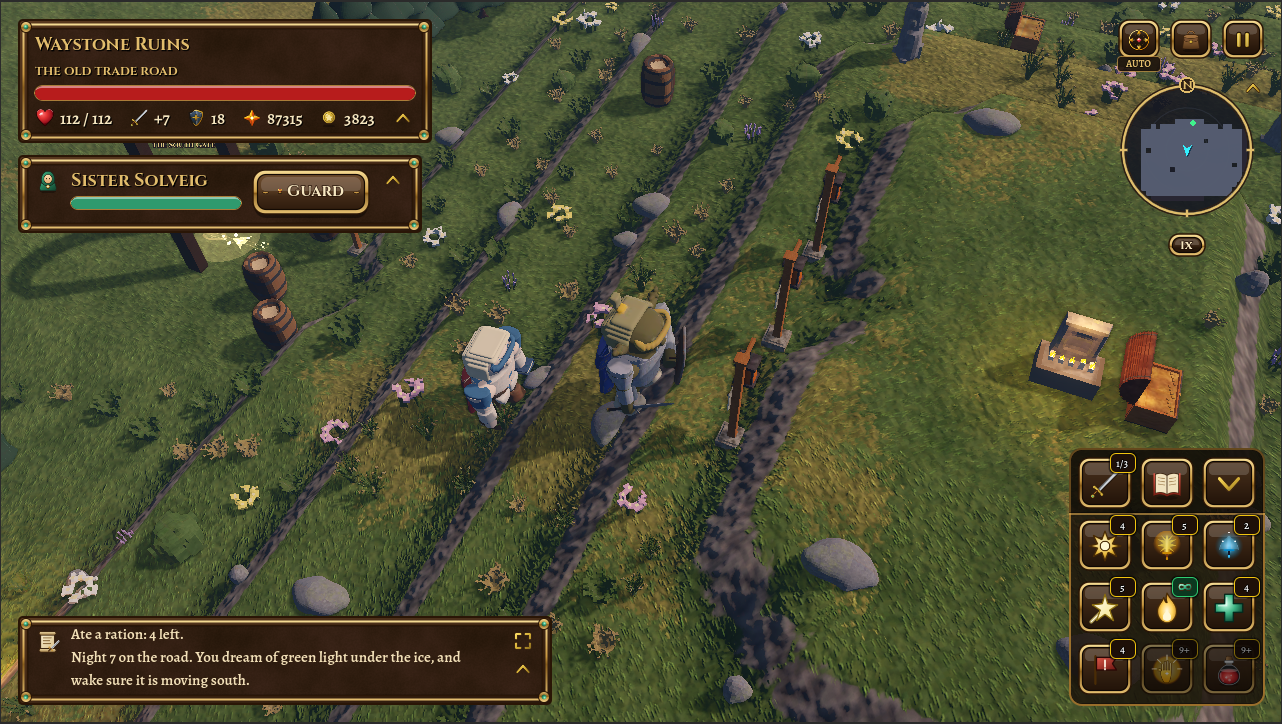
-
An Honest Character Sheet: Because the SRD 5.2 tables are huge, every class feature, feat, and trait you’re entitled to is still written onto your character sheet—but only the ones wired into gameplay carry a lit gem, while the rest are honestly marked as coming later.
Keeping the rules engine independent of Godot’s scene tree means gameplay rules can be tested without launching the game or simulating a frame. Whether it is an attack roll, a saving throw, spell damage, or character progression, the exact same deterministic rules are used by both the test suite and the running game—giving me confidence that tabletop mechanics stay consistent as the campaign and combat systems grow.
A single attack roll—including Advantage/Disadvantage, criticals, Sneak Attack/Rage riders, and Graze mastery—resolves deterministically in pure GDScript:
# domain/rules/combat.gd
static func resolve_attack(attack: AttackProfile, target: CreatureStats, advantage := 0,
		riders: Array = [], target_resistances := PackedStringArray(), high_ground := false) -> Dictionary:
	var d20 := Dice.lucky(Dice.d20(advantage), attack.lucky)
	var natural: int = d20["natural"]
	var bonus := attack.attack_bonus + (HIGH_GROUND_BONUS if high_ground else 0)
	var total := natural + bonus
	var critical := natural >= attack.crit_on
	# A Critical Hit always hits and a natural 1 always misses.
	var hit := critical or (natural != 1 and total >= target.armor_class)
	var damage := 0
	if hit:
		damage = Dice.roll(attack.damage_dice, critical, attack.min_die_face)
		# ... apply riders (Sneak Attack, Rage) and target resistances
	elif attack.mastery == "graze" and attack.ability_modifier > 0:
		damage = target.apply_damage_modifiers(attack.ability_modifier, attack.damage_type, target_resistances)
return { "natural": natural, "bonus": bonus, "total": total, "hit": hit, "critical": critical, "damage": damage }2. ASCII Maps: Jadefrost vs. The Jade Crypt
Just like The Jade Crypt, Jadefrost authors every level as a plain .txt ASCII grid (maps/<region>/<site>/<area>.txt). A shared parser (domain/map/map_parser.gd) and intermediate representation (MapIR) feed both the headless validator (tools/validate_maps.gd) and the 3D runtime builders (scripts/world/builder/).
However, moving from a 2.5D side-scrolling platformer to a 3D top-down isometric RPG forced a complete rethink of what an ASCII character represents.
| Aspect | The Jade Crypt (chambers/) |
Jadefrost (maps/) |
|---|---|---|
| Perspective | 2.5D side-view cross-section locked to \(Z = 0\) (X = horizontal, Y = vertical) | Top-down 3D world (X = east →, Z = south ↓; 1 m × 1 m columns) |
| Verticality (Y) | Row index is elevation; . is open air, is a bottomless abyss |
Elevation is encoded inside the glyph: ./0 = 0 m, 1–9 = raised contour metres, - = retain contour level, ^ v < > = 1 m stairs |
| Glyph Meaning | Global & fixed (n/N/W = sentinels, G/g = gates, K/D = keys/doors, T/t = lights) |
Map-local headers: only terrain and @ are global; letters like T, R, s, g are declared per-map in the header |
| Orientation | Facing derived from spawn or wall side | Optional [FACING] second grid using numpad digits (1–4, 6–9) per cell |
| World Stitching | Isolated chambers loaded one by one | [NEIGHBOUR:] stitches 12 overland tiles (4 × 3) with 14-cell preview scenery beyond borders |
Inside a Jadefrost Dungeon Map
Here is an excerpt from maps/jadefrost_city/watch_hall/crypt.txt (The Frostbound Crypt). Notice how the header binds glyphs locally to Seahill models, SRD monsters, loot registry keys, and skill spots:
[TITLE: The Frostbound Crypt]
[REGION: Jadefrost City]
[SITE: The Watch-Hall]
[KIND: dungeon]
[THEME: crypt]
[LIGHT: dim]
[WALL_HEIGHT: 3]
[EXIT: d = ossuary, Descend to the Ossuary, down]
[EXIT: u = courtyard, Climb to the Courtyard, up]
[MONSTER: a = skeleton-acolyte, Skeleton Acolyte, skeleton_acolyte, 1.0, , loot:monster-1]
[MONSTER: s = skeleton, Skeleton, skeleton_minion, 1.0, , loot:monster-3]
[MONSTER: W = skeleton-warden, Skeleton Warden, skeleton_warden, 1.15, , loot:monster-2]
[CHEST: c = chest-1]
[CHEST: C = chest-2, yaw=180]
[SPOT: j = study-the-cracked-jade-block-humming-in-the-wall]
[DECOR: O = seahill_dungeons/pillar, 0.625, height=3]
[DECOR: t = seahill_dungeons/wall_torch, 0.3, floor, lit, wall]
########################################
#t22u222t###########....f.....t...o....#
#222@2222###########................BB.#
#2222222############t..................#
#22222222###########....O.........O....#
##^^^^##############...................#
##^^^^##############.....b...s.........#
#.......c..R...#####..................t#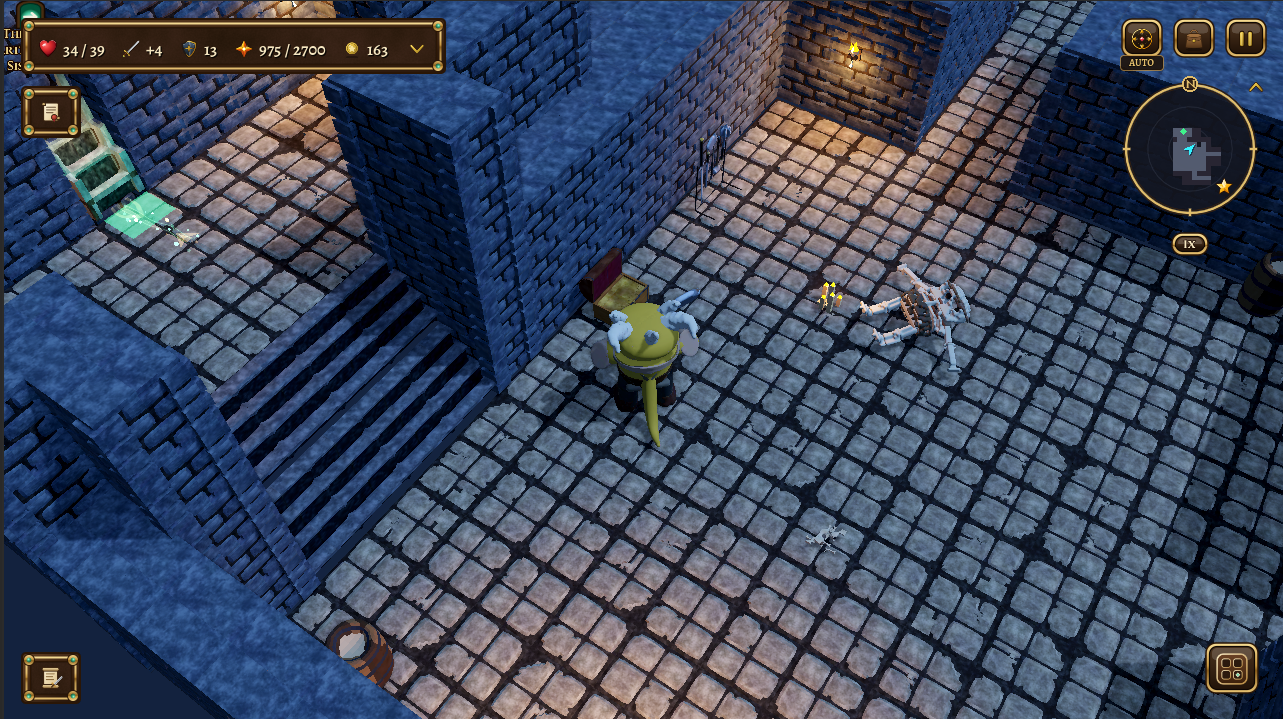
In this snippet:
@spawns the party on a2m high gatehouse landing (uclimbs back up to the courtyard).- Two rows of
^^^^step down 1 m per cell (2m \( \rightarrow \)1m \( \rightarrow \)0m.floor). splaces an SRDskeleton, while later in the crypt111W111raises the Skeleton WardenWonto a 1 m stone dais.
From Hand-Drawn World Contour to 12 Overland Tiles
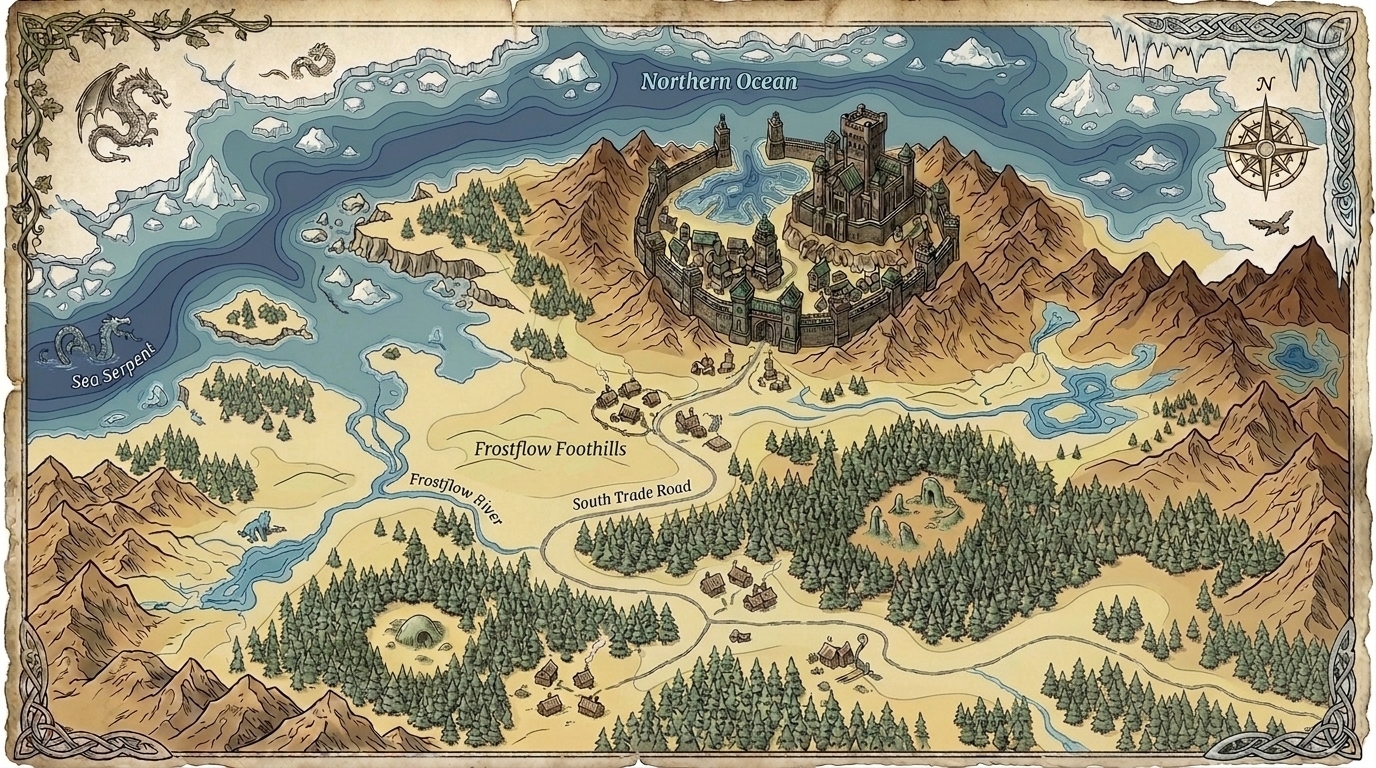
For outdoor regions, I didn’t draw 88-column wilds maps by hand from scratch. Instead, tools/world/generate_draft_map.gd reads assets/maps/world_map_contour.jpg (contour bands 0–5 and ~ water) alongside assets/maps/world_map.jpg (tracing roads into [ROAD:] ribbons, villages into [DECOR:] houses, and forests into pine trees T). It slices the world into a 4 × 3 grid of 12 overland .draft.txt tiles—each roughly 173 \(\times\) 126 m, complete with [NEIGHBOUR:] links for all eight compass directions.
And just like The Jade Crypt, every shipped map (all 41 maps in the repo) is verified headlessly by tools/validate_maps.gd (MAP-001 through MAP-039), which proves every monster, chest, exit, and skill spot is reachable from @ via valid stairs without clipping a 1 m cliff or hiding behind a south/east wall camera blind spot.
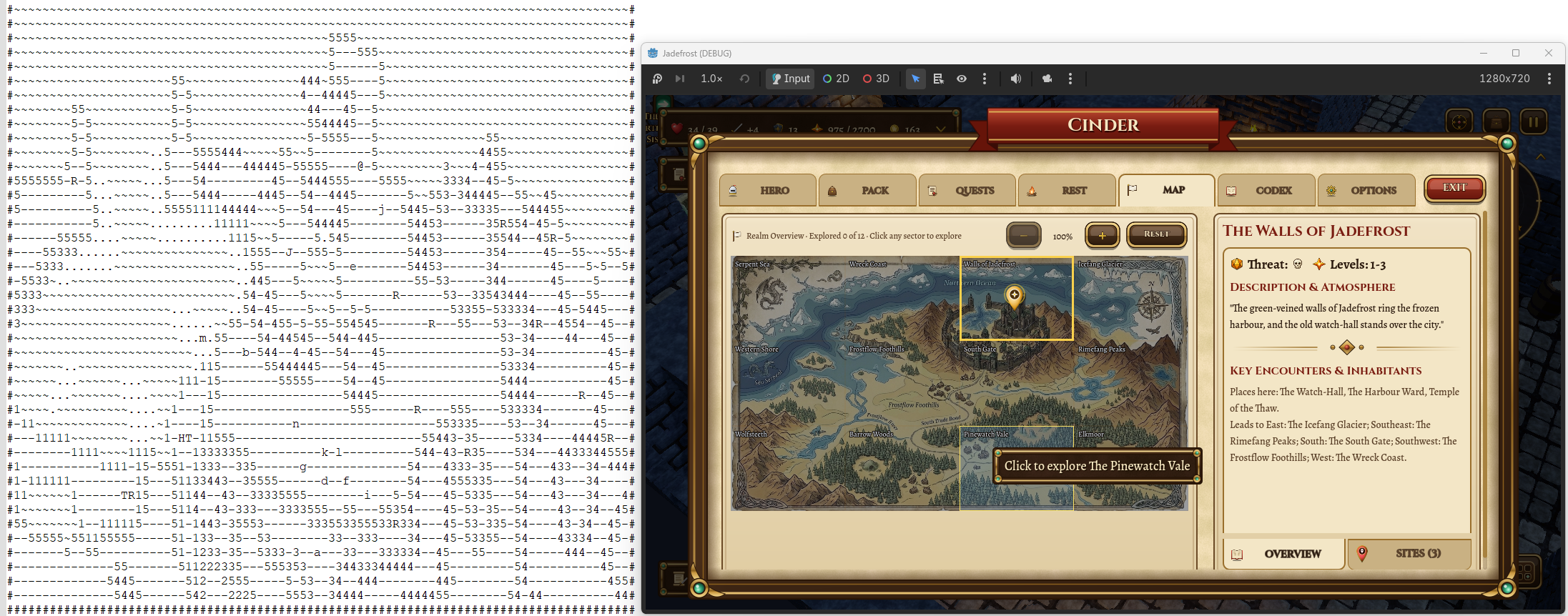
The interesting part is that these text files are more than level layouts—they act as a compact world-authoring language describing terrain elevation, navigation, monster placement, decorations, exits, and environmental relationships. The same MapIR representation is consumed by both the validator and the runtime builders, so what is considered walkable during validation is governed by the exact same rule used when the world is constructed in 3D:
# domain/map/map_ir.gd
func can_step(from: Vector2i, to: Vector2i) -> bool:
	var direction := to - from
	if absi(direction.x) + absi(direction.y) != 1:
		return false
	var a := edge_height(from, direction)
	var b := edge_height(to, -direction)
	if is_nan(a) or is_nan(b) or building_cells().has(to):
		return false
	# Outdoors the builder smooths the ground into one heightfield, so a 1 m
	# rise between neighbouring cells is a slope, not a cliff.
return absf(a - b) < (OUTDOOR_STEP if is_outdoor() else 0.01)3. Showing Off the Seahill Studio Kits
Every 3D model and spell effect in Jadefrost comes from my own
Seahill Studio
voxel and VFX pipelines. Keeping the asset kits modular—and separate from the game repo’s core gameplay logic—meant I could iterate on silhouettes, atlases, and rigs independently and sync them into assets/models/ and addons/seahill_vfx/.
Here is a quick tour of each kit and how Jadefrost uses it:
| Kit | Models / Scope | How Jadefrost Uses It |
|---|---|---|
seahill_species |
117 models (all 117 in use) | Covers all 9 playable species (human, elf, dwarf, halfling, gnome, orc, giantkin, hellkin, wyrm) across 13 class/skeleton bodies at real-world scale (~1.78 m for Medium). Drives player heroes, voiced NPCs, and humanoid foes. |
seahill_creatures |
9 models (8 in use) | Bone-rigged, procedurally animated creatures across five skeleton families (cow, deer, horse, wolf, giant_crab, serpent, roc, imp, and practice_dummy), exporting idle, walk, attack, hit, and die clips (or idle, hit, and die for the stationary dummy). |
seahill_dungeons |
41 models (15 in use) | Modular 1 m crypt kit used by DungeonCryptBuilder: flagstone variants (floor, floor_a, floor_b), walls, pillars, narrow stairs, altars, coffins, sarcophagi, urns, bone piles, and lit wall torches/candles. |
seahill_towns |
71 models (66 in use) | Town and village architecture—including seahill_cabin, seahill_cottage, and seahill_tavern—textured with a procedurally painted wood-grain and masonry town atlas. |
seahill_wilds |
29 models (all 29 in use) | Outdoor scenery with snow-split variants: pine trees (tree_pine_a/b), shrubs, rocks, stumps, campfires, wagons, wheelbarrows, barrels, crates, and roadside waystones. |
seahill_weapons |
32 models (equipped & floor drops) | Swords, axes, polearms, bows, crossbows, shields, quivers, spellcasting focuses, and weapon racks (rack_combat). Loaded dynamically by SRD index for equipped gear, NPCs, and physical 3D floor loot drops. |
seahill_armor |
171 models (species-fitted suits) | Voxel armor suits fitted per species (seahill_armor/<species>/<suit>.glb) across all 9 playable species, bound dynamically at runtime onto heroes, NPCs, and skeletons as you equip gear. |
seahill_vfx (addons/seahill_vfx) |
26+ spell compositions | Shader- and particle-driven spell effects (blast_shell.gdshader, lightning_stroke.gdshader, heat_haze.gdshader, spell_compositions.gd). Area spells translate the SRD’s imperial measurements into metre-based gameplay areas. For example, Fireball uses a 20-foot-radius sphere (6.096 m radius), while Lightning Bolt covers a 100-foot line (30.48 m). |
4. Reflections
Building Jadefrost brought those chalet D&D nights full circle. Watching a character roll 4d6 in the dice tray, pause mid-combat to cast Fireball across a 1 m ASCII-authored crypt, and read the exact d20 math in the log feels like sitting back at that table—except now the Game Master’s rulebooks live in data/srd/2024/, and validate_maps.gd makes sure nobody accidentally builds an unreachable dungeon room.
Jadefrost is also an opportunity to bring together several things I’ve been experimenting with: procedural world construction, reusable voxel asset kits, deterministic game rules, and Godot’s cross-platform rendering. There is still plenty to expand, particularly around the character features and gameplay mechanics that are currently marked as coming later. For now, I’m happy to have something playable that brings those old tabletop sessions a little closer to the digital RPGs that inspired me.
- Play Jadefrost in your browser: https://seehiong.itch.io/jadefrost
- Explore the Seahill Studio 3D kits: https://seahill.studio